Satellite close approaches
Predicted near passes between two objects in orbit, from CelesTrak SOCRATES. The map marks where the pair will be at its closest, and the card gives the time and miss distance. These are predictions that change as new orbit data arrives.
Free · No sign-up · Works in any browser
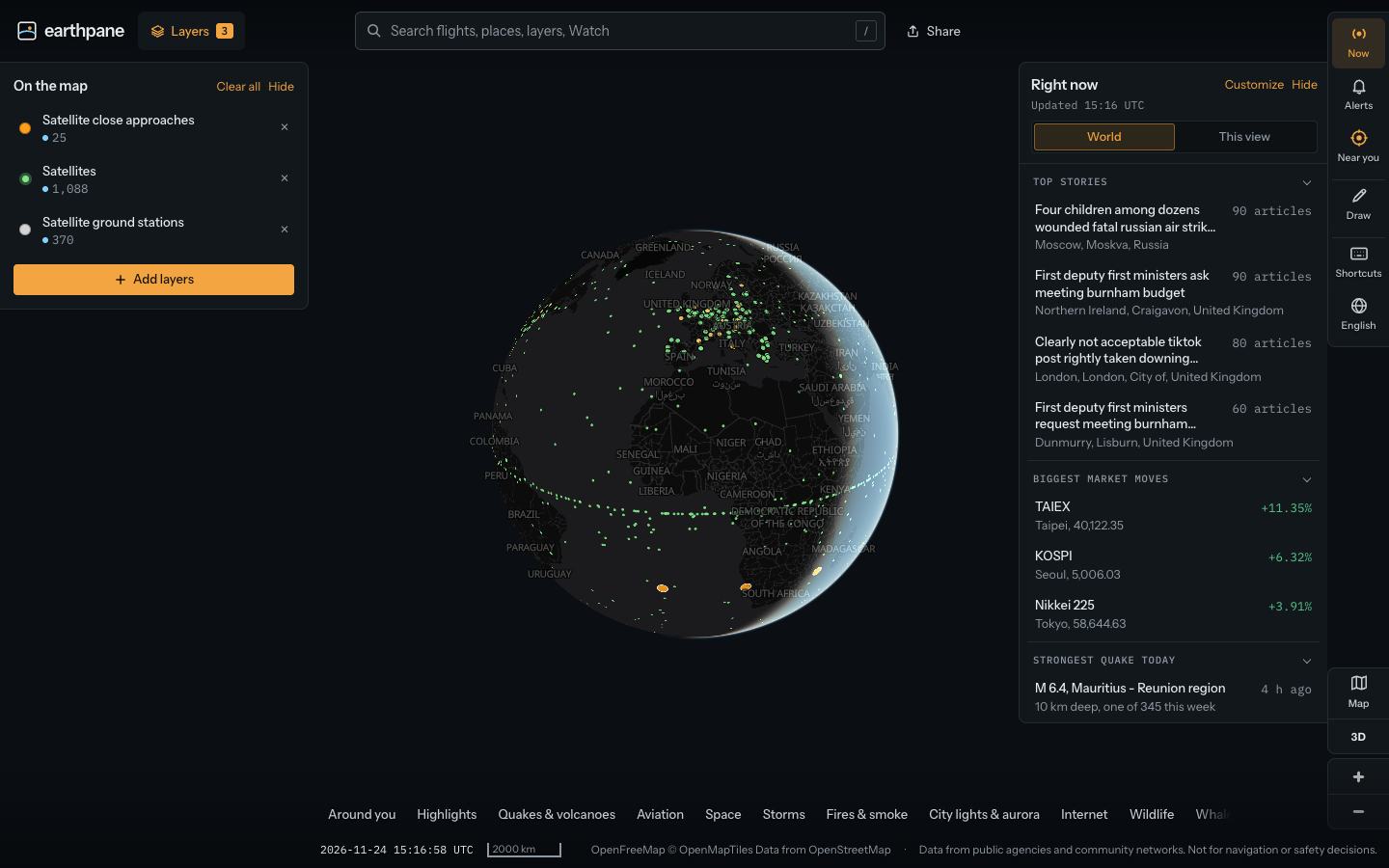
What's on the map
- Satellite close approachesSatellites due to pass dangerously close
- SatellitesActive satellites moving in real time
- Satellite ground stationsAntennas that talk to satellites
How to use it
- Open the map. Each orange dot marks the predicted point of closest approach for a pair of objects.
- Tap one for the two objects, the time of closest approach, the miss distance and relative speed.
- Read the maximum probability value from SOCRATES, which is a calculated estimate and not a forecast of a collision.
Questions
Does a close approach mean a collision?
No. The listed probability is a calculated estimate from SOCRATES, not a forecast of an impact.
How many events are shown?
Up to 25 events, ranked by the smallest predicted miss distance in the current SOCRATES list.
Why are these predictions?
They are computed from orbit data and shift as that data is updated, so treat them as estimates.
More live maps
- Live satellite trackerWatch thousands of satellites orbit Earth in real time on a 3D globe: Starlink, the ISS, weather and GPS satellites
- Satellite ground station mapSee satellite ground stations on a free map: the SatNOGS network of volunteer antennas, with status, owner and observation counts
- Starlink satellite trackerSee every Starlink satellite in orbit on a live 3D globe
- What's above me right nowSee what is flying above you right now: planes, satellites, the ISS, plus nearby quakes, fires and storms
- Meteor mapSee meteors caught by camera networks on a free 3D map, from the Global Meteor Network: shower, speed, height and the cameras that saw it
- Fireball mapSee fireballs (bolides) on a free 3D map: bright meteors detected by US government sensors, with impact energy, altitude and speed from NASA CNEOS